
Transfer Car Wheels — V-Groove and Flat Tread
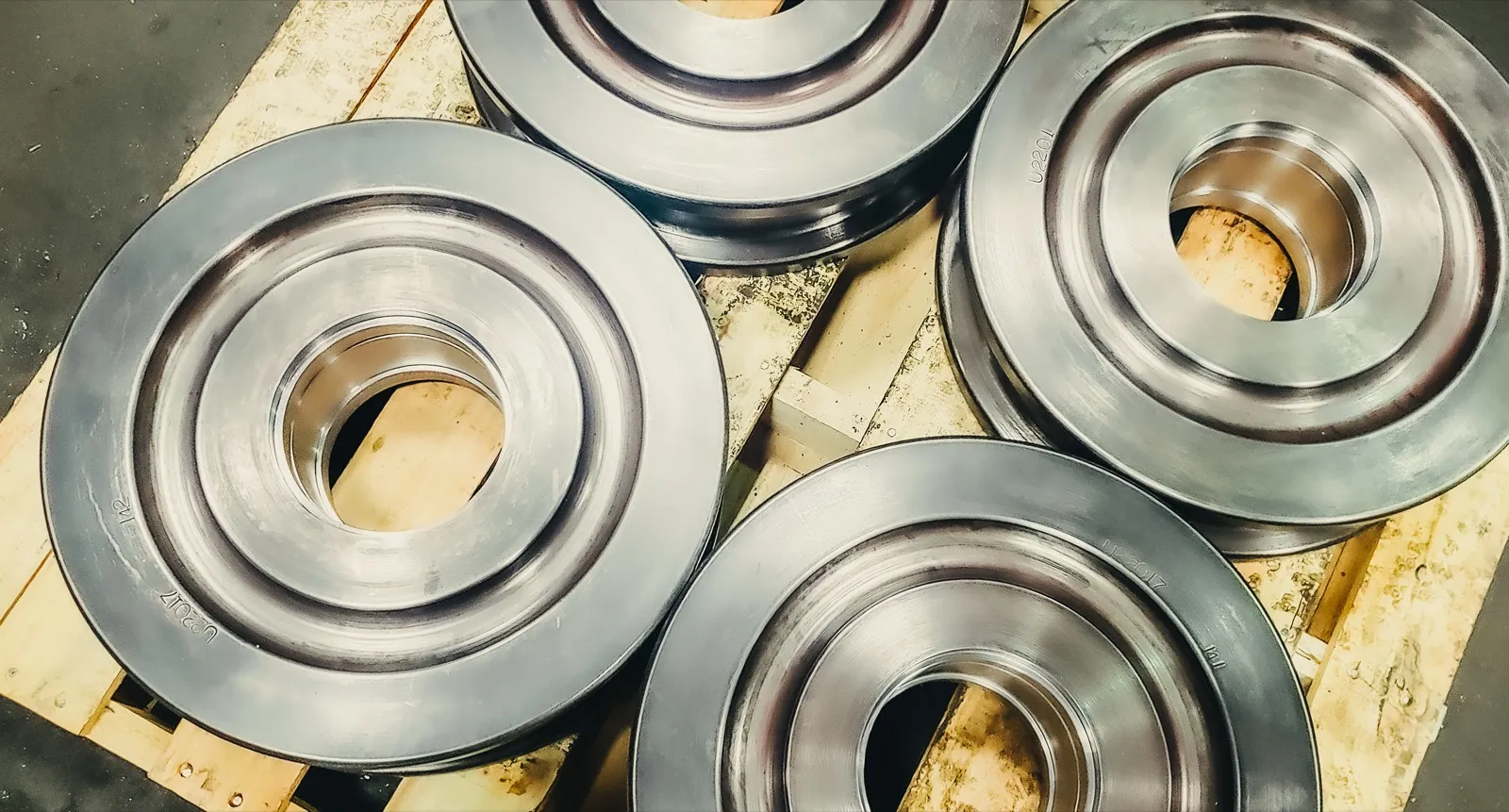
Alloy steel wheels for shop floor transfer cars, ladle transfer cars, coil cars, and embedded rail systems. V-groove profiles for square and angle-iron embedded rail. Flat tread for elevated rail. Custom to drawing or reverse-engineered from worn samples. Ships throughout North America.
Transfer Car Wheel Requirements — Different from Overhead Crane Wheels
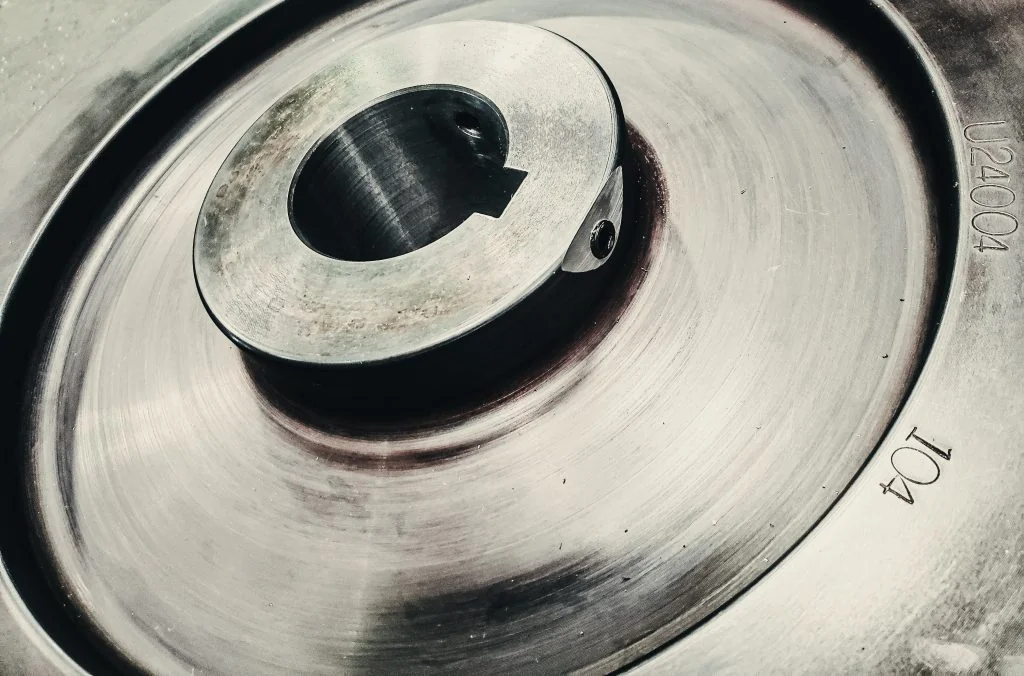
Transfer car wheels serve a fundamentally different duty than overhead crane end truck wheels. Where overhead crane wheels roll continuously under dynamic loads, transfer car wheels carry extreme dead loads — the weight of the car structure, any tooling or fixtures, and the payload — at very low speeds. A shop floor transfer car may travel only a few feet per minute while supporting tens of thousands of pounds. This produces high contact stress at low rolling velocity, a combination that favors tread hardness over toughness in the wheel specification.
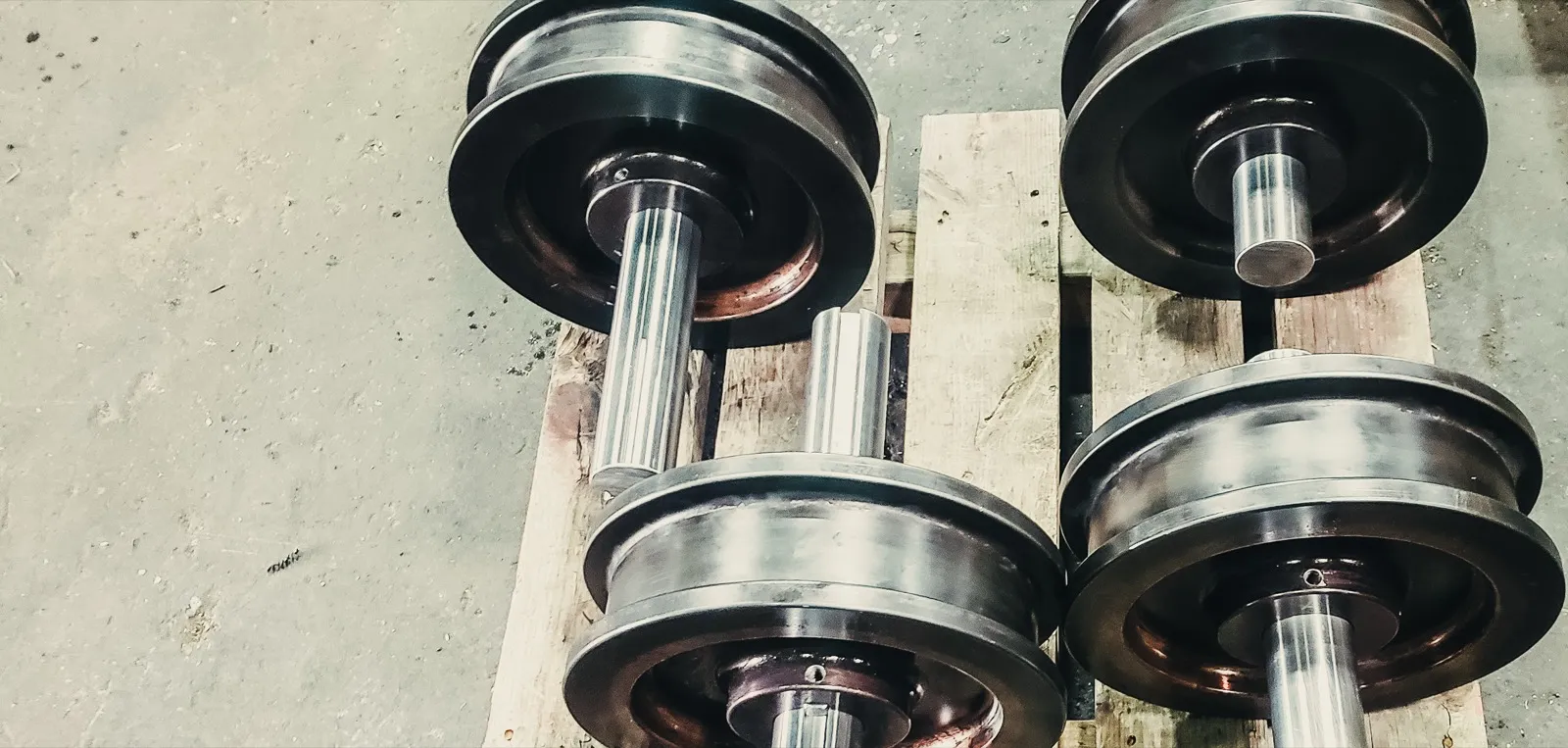
The rail type determines the wheel profile. Transfer cars running on elevated rail (channels or standard crane rail set on a structural frame) use flat tread or flanged wheels, the same as overhead crane end trucks. Transfer cars on embedded rail — where the rail is flush with the shop floor, typically fabricated from square bar, angle iron, or standard crane rail set in a concrete trench — use V-groove wheels. The V-groove engages the corner or crown of the rail, providing positive guidance without requiring flanges that would protrude above the floor surface.
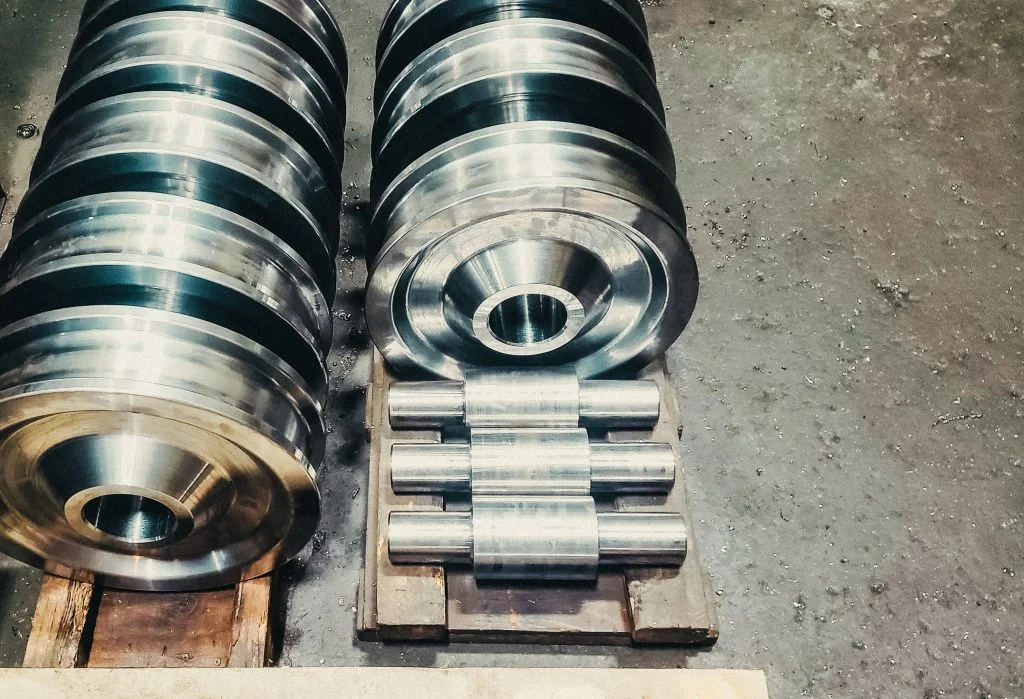
UTEC Industrial has manufactured transfer car wheels for primary-metals ingot-transfer systems and for lumber transfer applications. Both are production-critical systems where downtime is measured directly in lost throughput. UTEC's ability to reverse-engineer worn transfer car wheels without drawings — a common situation in older plants where original documentation no longer exists — has been the fastest path to a working replacement in most of these cases.
V-Groove vs. Flat Tread — Choosing the Right Profile
| Feature | V-Groove | Flat Tread |
|---|---|---|
| Rail type | Embedded square bar, angle iron, or V-rail | Elevated flat-head rail, channel, or standard crane rail |
| Guidance method | Rail corner engages groove — no flange required | Flange on wheel contacts rail web or side |
| Floor clearance | Rail flush with floor; car can run over without tripping hazard | Rail elevated; flanges hang below floor level |
| Common applications | Shop floor transfer cars, die transfer, ladle transfer | Elevated rail transfer systems, cranes on runway |
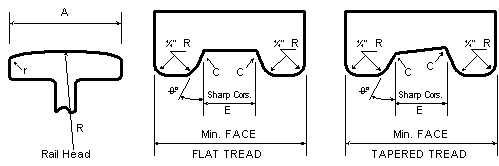
| Groove angle | Typically 60° or 90° to match rail geometry | N/A |
| Tread hardness | 50–58 HRC (Rockwell C hardness) — contact stress is high at low speed | 50–58 HRC for standard duty |
Ladle Transfer Cars — Severe Duty Near the Melt Shop
Ladle transfer cars in steel mills and foundries present the most severe duty in the transfer car category. The wheel runs at low speed under extreme load — a full ladle of molten metal can weigh hundreds of tons — while exposed to spatter, radiant heat from the ladle, and corrosive gases from the melt. For ladle car service, UTEC specifies AISI (American Iron and Steel Institute) 4340 rather than 4140. The nickel-chromium-molybdenum chemistry of 4340 provides superior toughness at elevated ambient temperatures and better resistance to the thermal cycling that occurs as the ladle car passes repeatedly near the melt. For complete coverage of CMAA (Crane Manufacturers Association of America) Class E and F severe-duty specification, see the Ladle & Foundry Cranes page.
Transfer Car Wheel Capabilities
| Parameter | UTEC Capability |
|---|---|
| V-Groove Angles | 60°, 90°, and custom angles to drawing |
| Flat Tread Width | To customer specification |
| Tread Diameter | 6-inch to 48-inch |
| Alloy Grade | AISI 4140 (standard), 4340 (ladle car and severe duty), 1045 (light duty) |
| Tread Hardness | 50–58 HRC; to customer specification |
| Bore Types | Press-fit, thermal installation, keyed, bearing assembly |
| Heavy-Load Bores | Large interference fits for high dead-load applications — to drawing |
| Rail Compatibility | Square bar, angle iron, V-rail, standard crane rail — to customer rail spec |
| Documentation | Raw material chemistry, hardness reports, dimensional inspection |
Frequently Asked Questions
What is the difference between V-groove and flat tread for transfer car wheels?
V-groove wheels engage an embedded rail — typically square bar or angle iron set flush with the shop floor — using a machined groove on the wheel tread face. The groove profile matches the rail geometry (typically 60° or 90° V-angle) and provides positive lateral guidance without requiring flanges that would project above the floor surface. Flat tread wheels run on elevated rail (a standard crane rail or channel set on a structural frame), with flanges on the wheel providing lateral guidance as with overhead crane end trucks. V-groove is the standard for embedded-rail shop floor transfer cars; flat tread or flanged wheels are used when the rail is elevated.
What rail type does a V-groove transfer car wheel work with?
The most common V-groove rail configurations are: (1) square bar embedded in a concrete floor trench, where the V-groove engages two edges of the square section; (2) angle iron embedded with the corner pointing up, where the groove rides on the angle point; (3) machined V-rail, a dedicated rail section with a precisely ground V-profile for high-accuracy applications. The groove angle on the wheel must match the included angle of the rail profile — UTEC machines the groove to the customer's rail specification. If the existing rail geometry is unknown, sending a cross-section photograph or a 3D trace of the rail profile gives UTEC enough information to quote the correct groove geometry.
Can UTEC manufacture replacement transfer car wheels without drawings?
Yes — reverse engineering from worn samples is UTEC's standard path for transfer car wheel replacement when drawings are unavailable. Transfer car wheels are particularly well-suited to remote reverse engineering because the bore diameter and V-groove geometry are typically measurable from photos and measurements even when the tread face is heavily worn: the groove retains its profile until the tread is nearly consumed, and the bore is protected from wear. Send UTEC photos and measurements — no need to ship the part. UTEC will produce a drawing for customer approval before manufacturing. Call (509) 922-1832 or use the contact form to start the process.
What alloy grade is recommended for ladle car service near a melt shop?
AISI 4340 (nickel-chromium-molybdenum) is the standard recommendation for ladle transfer car applications in steel mill and foundry environments. The elevated ambient temperature near the melt shop reduces the toughness of the hardened martensitic case in lower-alloy steels like 4140; 4340's nickel content stabilizes toughness at elevated temperatures. Additionally, the extreme dead load of a full ladle car produces very high contact stress at the wheel-rail interface — 4340's superior hardenability ensures a deeper, more uniform hardened case that resists subsurface fatigue under these loads. Case depth specification for ladle car wheels should be reviewed relative to the contact stress calculation for the specific wheel diameter and load.
Technical Reference Library
Steel Crane Wheel Solutions
Request a Transfer Car Wheel Quote
Tell us your rail type, groove angle, wheel diameter, alloy grade, and quantity — or send photos and measurements of your worn wheel. UTEC responds within one business day.
Get a QuoteLast updated: