
UTEC Industrial · Steel Crane Wheels
Custom Alloy Steel Crane Wheels — Built to Your Specification
UTEC Industrial manufactures crane wheels to your alloy grade and hardness requirements — precision-machined from high-alloy steel billet, hardened in-house to 50–58 HRC, and shipped throughout the United States, Canada, and Mexico. No catalog. No distributor's warehouse. Built to your specification, from our shop in Spokane Valley, WA.
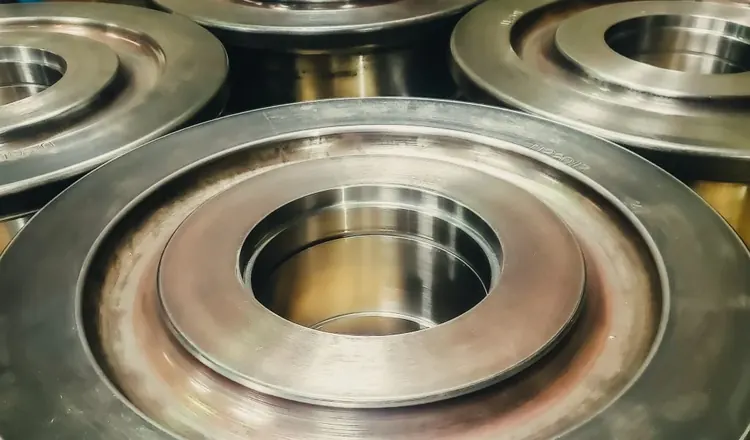
Why Buyers Specify UTEC Crane Wheels
Your Alloy. Your Hardness.
Every UTEC wheel is manufactured to the customer's chemical and hardness specification. You specify the alloy grade — AISI (American Iron and Steel Institute) 1045, 4140, 4340, or 8620 — and the target Rockwell hardness. UTEC procures the billet and hardens in-house to that value. No catalog substitutions. No distributor picking the closest thing on a shelf.
In-House Induction Hardening — No Subcontracting
UTEC performs induction hardening in-house on every wheel. Case depth and surface hardness are verified by Rockwell testing before shipment. No heat-treat subcontractor delays, no handoffs, no quality gaps between machining and hardening. One facility, one accountable supplier, complete raw material chemistry documentation available on every order.
In-Stock Billet — Start Today, Not Next Week
UTEC maintains alloy steel billet stock in AISI 4140 and 4340. When you need replacement wheels, machining begins immediately — not after procurement. UTEC ships throughout the United States, Canada, and Mexico. Buyers in the Pacific Northwest benefit from shorter freight runs, but UTEC supplies customers nationwide on the same terms.
Crane Wheel Capabilities
| Capability | Specification |
|---|---|
| Raw Material | AISI 1045, 4140, 4340, 8620 high-alloy steel billet — 4140 and 4340 in stock |
| Turning Capacity | Up to 48-inch (1219 mm) diameter × 60-inch (1524 mm) length |
| Machining Tolerance | ±0.001 inches (±0.025 mm) on tread diameter and bore |
| Tread Hardness | 50–58 HRC standard; other values to customer specification |
| Hardening Method | In-house induction hardening — no subcontracting |
| Case Depth | Specified per application; typical range 0.25–0.75 inches (6.4–19 mm) |
| Tread Profiles | Flat, tapered, single-flange, double-flange, V-groove, custom |
| Bore Types | Press-fit, thermal installation (shrink-fit), keyed, bearing assembly |
| CMAA (Crane Manufacturers Association of America) Service Class | Class A through Class F |
| Custom Options | To engineering drawing, OEM part number, or reverse-engineered from worn sample |
| Documentation | Complete raw material chemistry, hardness test reports, dimensional inspection, heat treat certs |
| Ships To | United States, Canada, Mexico |
Three Ways to Order
Crane Down — Need Wheels Fast
Send UTEC what you have — a part number, a description, a worn wheel, or a rough sketch. We will turn a quote within one business day and begin production on the fastest schedule the job requires.
Rapid ReplacementCustom to Your Drawing or OEM Spec
You have an engineering drawing, OEM part number, or a written specification. UTEC manufactures to your exact alloy, target Rockwell hardness, geometry, and bore requirements. Accepts DXF, PDF, paper drawings, or inch/metric specifications.
Custom to DrawingNo Drawing — Send Photos & Measurements
No drawing. No part number. Send UTEC photos, measurements, and any available specs — our engineers reconstruct the geometry remotely, produce engineering drawings for your approval, and manufacture exact-fit replacements. No need to ship the part.
Reverse EngineeringCrane Wheel Applications
Overhead & Bridge Cranes
End truck and trolley wheels for top-running and under-running overhead bridge cranes. CMAA Class A through D. Flat, tapered, and flanged profiles to rail specification.
Overhead & Bridge CranesGantry & Portal Cranes
Large-diameter wheels for rail-mounted outdoor gantry systems. Up to 48-inch diameter. Full-gantry, semi-gantry, and portal configurations.
Gantry & Portal CranesTransfer Cars
V-groove and flat tread wheels for shop floor transfer cars, ladle transfer cars, and embedded rail systems. Custom to drawing or reverse-engineered.
Transfer CarsLadle & Foundry Cranes
Severe-duty Class E and F wheels for ladle cranes, foundry cranes, and steel mill bridge cranes. AISI 4340, in-house hardening, NDE documentation available.
Ladle & Foundry CranesSheaves & Reeving Blocks
Precision-machined alloy steel sheave wheels for crane hoisting systems. Custom groove profiles, wire rope compatibility, in-house hardening. To drawing or reverse-engineered.
Sheaves & Reeving BlocksTread Profiles & Flange Configurations
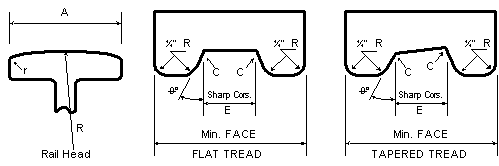
| Profile | Typical Application |
|---|---|
| Flat tread | Standard overhead bridge and gantry cranes on flat-head rail |
| Tapered tread | Self-centering applications; reduces flange-to-rail contact on straight runs |
| Single-flange | One-rail guidance; common on paired end truck wheelsets |
| Double-flange | Both rails guided; transfer cars, low-clearance, embedded rail |
| V-groove | Embedded square or angle-iron rail; shop floor transfer cars |
| Custom | Radiused, combination profiles, non-standard gauge — to drawing |
Custom Crane Wheels, Shipped Throughout North America
UTEC ships alloy steel crane wheels throughout the United States, Canada, and Mexico. Orders are manufactured in Spokane Valley, Washington and ship by common carrier or expedited freight to customers in every region. Buyers in the Pacific Northwest typically benefit from faster delivery times due to UTEC's location, but UTEC supplies customers from coast to coast and across North America on the same terms. Call (509) 922-1832 to discuss timeline for your location and order.
Frequently Asked Questions
What alloy steel grades does UTEC use for crane wheels?
UTEC machines crane wheels from AISI 1045, 4140, 4340, and 8620 high-alloy steel billets. AISI 4140 (chromium-molybdenum) is the most commonly specified grade for general industrial crane service — it achieves consistent tread hardness of 50–55 HRC with case depths of 0.25–0.50 inches and is appropriate for CMAA Class C through D service. AISI 4340 (nickel-chromium-molybdenum) is specified for severe-duty Class E and F applications, large-diameter wheels, and high-impact service such as ladle cranes, where 4140 would develop subsurface fatigue. AISI 1045 is used for light-duty Class A and B applications where cost is a primary driver and full hardenability is not required. AISI 8620 is a case-hardening grade used in drive wheels subject to torsional stress. UTEC can provide complete raw material chemistry documentation — the full chemical composition of the steel — for every wheel it manufactures.
Can I specify the exact tread hardness I need?
Yes. UTEC produces crane wheels to customer-specified tread hardness rather than a catalog range. Typical tread hardness for general industrial service is 50–58 HRC (approximately 480–620 BHN) achieved through in-house induction hardening. If your application requires a specific Rockwell or Brinell value within this range — or outside it, where achievable within the alloy's capability — specify it on your drawing or purchase order and UTEC will manufacture to that value. Hardness test results are provided with every shipment, taken at multiple points around the tread circumference to confirm uniformity.
What is in-house induction hardening and why does it matter?
Induction hardening uses an electromagnetic coil to rapidly heat the tread surface above its austenitizing temperature, followed by a controlled quench. This creates a hard martensitic case at the tread — typically 50–58 HRC — while the wheel core retains its original toughness. UTEC performs this process in-house, meaning there is no subcontractor involved between machining and hardening. This matters for two reasons: first, it eliminates the lead time and coordination risk of sending wheels to an outside heat treater; second, it gives UTEC direct control over case depth and hardness uniformity, verified by Rockwell testing before shipment. A wheel that arrives from UTEC has been machined, hardened, inspected, and documented at one address.
What is the maximum crane wheel diameter UTEC can manufacture?
UTEC's CNC turning capacity is up to 48 inches in diameter and 60 inches in length, accommodating the largest crane wheels used in industrial gantry, ladle, and portal crane applications. For reference, most standard overhead bridge crane end truck wheels range from 12 to 30 inches in diameter — UTEC's capacity handles wheels well beyond this range. If your wheel diameter requirement is unclear, contact UTEC with the crane nameplate capacity and wheel base and UTEC can advise on the required diameter range.
Can UTEC manufacture wheels to CMAA specifications?
Yes. UTEC manufactures crane wheels to CMAA Specification No. 70 (top-running overhead and bridge cranes) and No. 74 (underhung cranes), including material, hardness, and dimensional requirements for Class A through Class F service. When ordering, specify the CMAA service class and UTEC will confirm the appropriate alloy grade and hardness range. If you have existing wheels that predate CMAA standards or were specified to a different standard (AISE, DIN, etc.), UTEC can manufacture to the dimensional and hardness requirements stated on the drawing.
Can UTEC reverse-engineer a crane wheel from a worn sample with no drawing?
Yes — approximately 90% of UTEC's crane wheels are produced to customer drawings or by reverse engineering from worn samples. The process starts with photos and measurements submitted by the customer — no need to ship the part. UTEC engineers reconstruct all critical geometry from the submitted documentation, produce a dimensioned engineering drawing, and send it to the customer for approval before machining begins. Replacement wheels are manufactured to the confirmed drawing with in-house induction hardening. If wear patterns indicate the original specification was inadequate — insufficient hardness, wrong alloy, mismatched tread profile — UTEC flags this and recommends improvements before manufacturing. Full reverse engineering process →
How fast can UTEC turn a replacement crane wheel order?
Standard production lead time varies with order complexity, wheel diameter, and current shop load — contact UTEC with your requirements for a current estimate. For emergency downtime situations, UTEC maintains billet stock in AISI 4140 and 4340 and can begin machining immediately upon receipt of a complete drawing or worn wheel sample, without a material procurement wait. Expedited production is available. The fastest path is to call UTEC directly at (509) 922-1832 and describe your situation — UTEC's production team will give you a realistic timeline for your specific wheel.
Does UTEC ship crane wheels outside the Pacific Northwest?
UTEC ships crane wheels throughout the United States, Canada, and Mexico. While buyers in the Pacific Northwest benefit from UTEC's Spokane Valley location for freight timing, UTEC regularly supplies customers in California, Texas, the Gulf Coast, Midwest, and East Coast. Shipping method and carrier are coordinated with the customer based on timeline requirements. Expedited freight is available for emergency replacement orders regardless of destination.
Technical Reference Library
Every specification question answered in depth at the UTEC Crane Wheel Resource Center.
Request a Crane Wheel Quote
Tell us your alloy grade, hardness requirement, dimensions, and quantity — or send photos and measurements of your worn wheel. UTEC responds within one business day.
Get a QuoteLast updated: