
Ladle & Foundry Crane Wheels — Class E and Class F Severe Duty
UTEC Industrial manufactures severe-duty alloy steel crane wheels for ladle cranes, foundry bridge cranes, and CMAA (Crane Manufacturers Association of America) Class E and F steel mill applications. AISI (American Iron and Steel Institute) 4340 billet, in-house induction hardening to customer-specified Rockwell hardness, case depth to drawing. Full documentation including NDE available. Ships throughout North America.
The Most Demanding Crane Wheel Application in Industry
CMAA service classification is a duty cycle specification — it quantifies how hard a crane works relative to its rated capacity and how frequently. Class E (severe duty) is defined by cranes handling loads approaching rated capacity during 65–80% of working time, with 10–20 starts per hour. Class F (continuous severe duty) represents the most demanding category: steel mill cranes — ladle cranes, stripper cranes, soaking pit cranes — that operate continuously at or near rated capacity with starts exceeding 20 per hour. These cranes do not rest. They work every shift, every day, and their wheels accumulate load cycles that would represent years of service for a Class C overhead crane in a matter of months.
Ladle cranes carry the entire weight of a ladle of molten metal — the ladle structure itself plus the liquid steel or aluminum. A full steel ladle in a large melt shop can weigh 300 tons or more. This load passes through the crane wheels to the runway rails, producing contact stresses at the wheel-rail interface that approach or exceed the fatigue limit of lower-alloy steels. Simultaneously, the ambient temperature at the melt floor — from radiant heat of the ladle and the surrounding furnaces — reduces the impact toughness of hardened steel and accelerates oxidation of unprotected surfaces. The wheel specification for Class F service must account for all of these simultaneously.
The consequence of underspecifying a ladle crane wheel is not gradual degradation — it is sudden catastrophic failure in the worst possible environment. A spalled or cracked wheel tread on a crane carrying molten metal is a safety event, not a maintenance event. UTEC approaches Class E and F wheel specifications accordingly: the alloy grade, hardness, case depth, and documentation requirements are confirmed before manufacturing begins, and any ambiguity in the specification triggers a customer contact before production proceeds.
Why AISI 4340 Is the Standard for Ladle and Foundry Service
AISI 4340 differs from 4140 in one critical way: it contains 1.65–2.00% nickel in addition to the chromium and molybdenum that 4140 already carries. This nickel addition does two things. First, it significantly improves hardenability — 4340 produces a deeper, more uniform martensitic case in large-diameter wheel sections where 4140 may harden unevenly through a thick cross-section. Second, it improves toughness in the hardened condition — 4340 tempered to 50–55 HRC (Rockwell C hardness) retains substantially higher Charpy impact energy than 4140 at the same hardness, which matters in the shock loading environment of a ladle crane operating at maximum starts per hour.
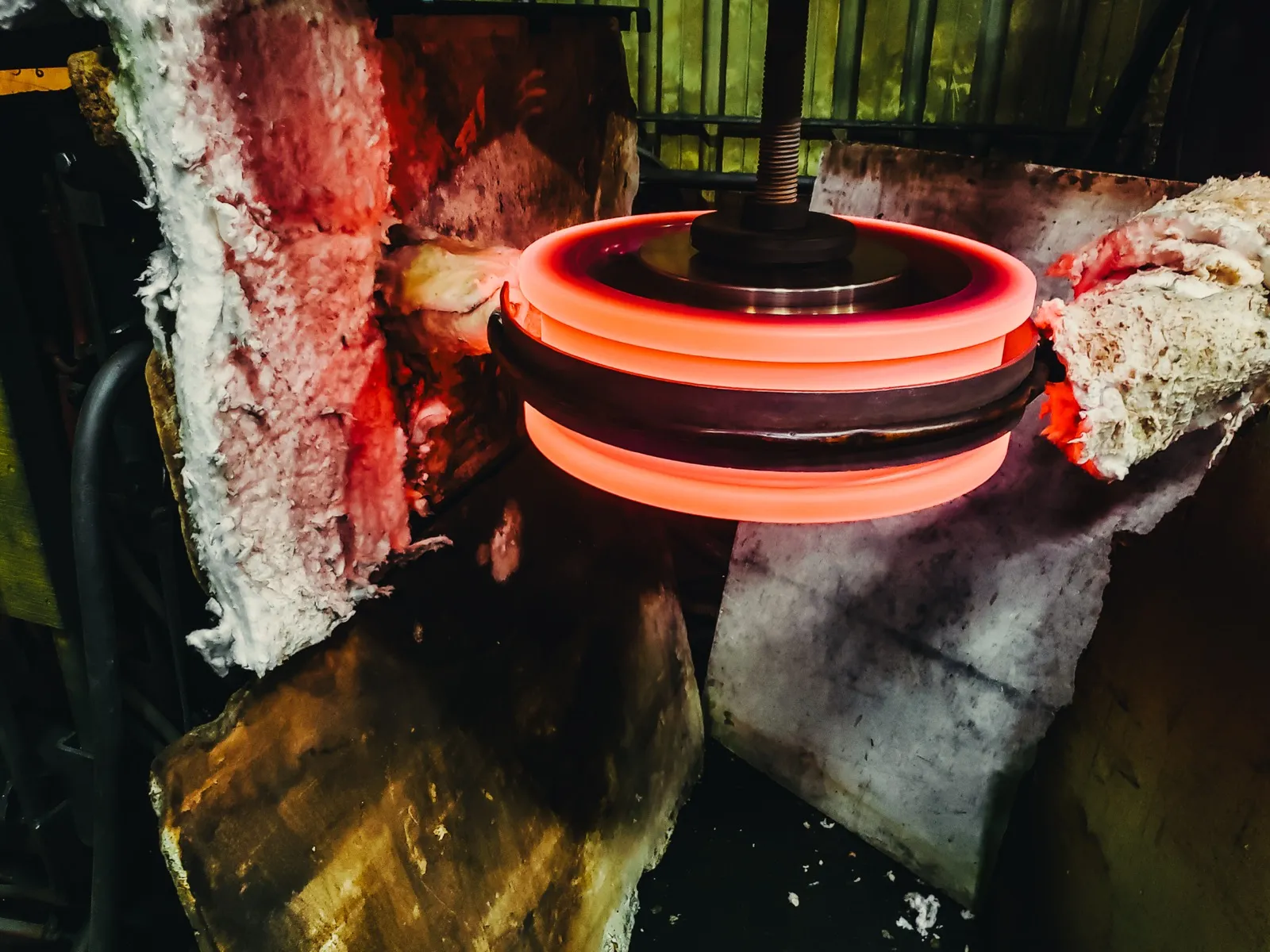
Through-hardening — hardening the entire wheel cross-section to uniform high hardness — is not recommended for ladle crane service despite the high duty requirement. A fully through-hardened wheel is brittle: cracks initiate at stress concentrations and propagate rapidly. Induction surface hardening of the tread, combined with AISI 4340 for a tough core, produces the correct mechanical profile: hard where contact stress requires it, tough where impact resistance is needed.
For CMAA Class F service at the upper end of the hardness range (370–420 BHN), alloy procurement confirmation is part of UTEC's pre-production process. UTEC provides the complete raw material chemistry — the actual quantified alloy composition — so the customer can verify that the steel's hardenability matches the requirement before wheels are delivered to a melt shop.

Ladle & Foundry Crane Wheel Capabilities
| Parameter | UTEC Capability |
|---|---|
| Primary Alloy | AISI 4340 (standard for Class E–F); 4140 available for Class C–D |
| Turning Capacity | Up to 48-inch (1219 mm) diameter × 60-inch (1524 mm) length |
| Tread Hardness | 370–420 BHN (40–45 HRC) for Class E–F; to customer specification |
| Hardening Method | In-house induction hardening — tread surface only, core preserved tough |
| Case Depth | Deeper specification available for Class F — confirm on drawing |
| CMAA Classes | E and F (ladle, foundry, mill service); A–D also available |
| NDE Documentation | Available on request — magnetic particle, ultrasonic per ASTM |
| Raw Material Chemistry | Complete chemical composition provided standard |
| Hardness Documentation | Rockwell test results at multiple tread positions |
| Dimensional Inspection | To drawing tolerances; report provided with shipment |
Frequently Asked Questions
What CMAA service class covers ladle cranes?
Most ladle cranes in active steel mill service are CMAA Class E (severe duty, 65–80% of working time at near-rated capacity, 10–20 starts per hour) or Class F (continuous severe duty — the highest CMAA classification, used for cranes in continuous production service with no meaningful idle time). The CMAA service class should be confirmed from the crane manufacturer's nameplate or original documentation. If the service class is unknown, UTEC can advise based on a description of the crane's duty cycle — daily hours of operation, typical load as a fraction of rated capacity, and starts per hour are sufficient to estimate the appropriate class.
Why is AISI 4340 preferred over 4140 for Class E and F service?
AISI 4340's nickel-chromium-molybdenum chemistry provides two advantages over 4140 in severe-duty service. First, superior hardenability: 4340 produces a deeper, more uniform hardened case in large-diameter wheel sections — sections above 30 inches in diameter that may harden inconsistently in 4140 harden predictably in 4340 due to better alloy depth. Second, higher toughness at equivalent hardness: when tempered to Class E/F hardness ranges (370–420 BHN), 4340 retains substantially higher Charpy impact energy than 4140, providing better resistance to the shock loading that occurs at high cycle rates on ladle cranes. The cost premium for 4340 over 4140 billet is typically 20–40% on raw material — easily justified against the cost of a premature failure on a ladle crane.
Can UTEC provide NDE inspection documentation for ladle crane wheels?
Yes. Non-destructive examination (NDE) — including magnetic particle inspection (MPI) for surface and near-surface discontinuities and ultrasonic testing (UT) for internal soundness — is available as a supplementary documentation option. Specify NDE requirements on the purchase order or drawing, including the applicable ASTM standard and acceptance criteria. Common NDE specifications for severe-duty crane wheels include ASTM E709 (magnetic particle) and ASTM E114 (ultrasonic). NDE is performed and documented before shipment; test reports are provided with the documentation package. If NDE is required to a customer-specific procedure rather than a published ASTM standard, contact UTEC before placing the order to confirm procedure availability.
What case depth should be specified for Class F ladle crane service?
For CMAA Class F service, a minimum tread case depth of 0.50 inches is generally appropriate for wheel diameters in the 24–36 inch range; larger wheels may require 0.60–0.75 inches. The case depth must be sufficient to contain the high-stress subsurface zone below the wheel-rail contact patch — subsurface fatigue cracks initiate at depths related to the Hertzian contact stress distribution, which depends on wheel diameter, load, and tread profile. If your application is at the upper end of Class F severity, UTEC recommends specifying case depth on the drawing rather than accepting a default value, and providing the wheel load and rail specification so UTEC can confirm the specified depth is adequate for the contact geometry.
What is the typical replacement interval for Class F ladle crane wheels?
Replacement interval for Class F ladle crane wheels varies significantly with load magnitude, starts per hour, rail condition, and wheel specification. As a general benchmark, well-specified 4340 wheels in active steel mill ladle crane service typically achieve 2–5 years before tread wear reaches the replacement threshold defined in CMAA Spec. #70. Wheels in particularly aggressive service — maximum load cycling, abrasive rail surface contamination, or elevated ambient temperature above 400°F — may require replacement in 12–24 months. Maintaining a spare wheel set at the facility and establishing a documented inspection interval (measuring tread diameter against the minimum tread diameter on the drawing) is the best practice for Class F cranes. UTEC can supply spare sets with any replacement order.
Technical Resources
Explore Steel Crane Wheel Solutions
Request a Quote for Ladle or Foundry Crane Wheels
Send UTEC your drawing, CMAA service class, wheel load, and NDE requirements. UTEC responds within one business day.
Get a QuoteLast updated: