
Overhead & Bridge Crane Wheels
Custom alloy steel end truck and trolley wheels for top-running and under-running overhead bridge cranes. CMAA (Crane Manufacturers Association of America) Class A through D. Flat, tapered, and flanged tread profiles. Manufactured to drawing, OEM part number, or reverse-engineered from worn samples. Ships throughout North America.
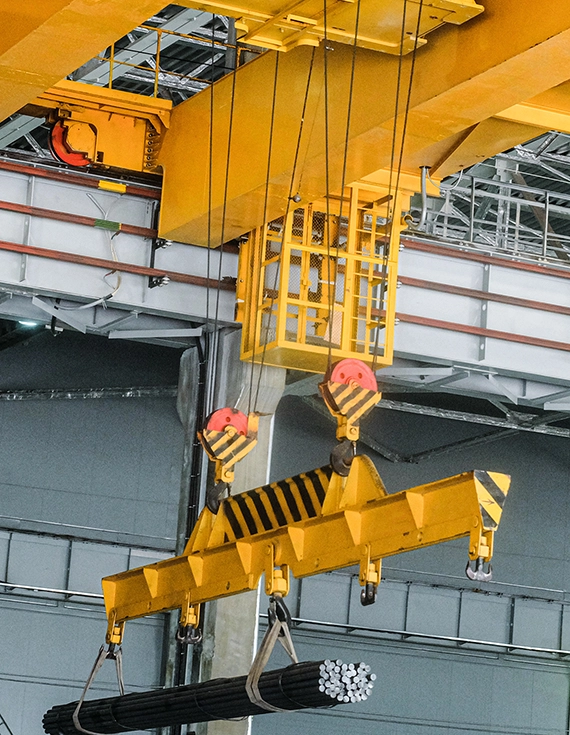
End Truck Wheels for Overhead Bridge Cranes
Overhead bridge cranes use four running wheels in each end truck — two drive wheels connected by the drive shaft and two idler wheels. The drive wheels must transmit traction force to the rail and resist torsional stress; idler wheels carry load and guide the bridge. Material and hardness specification for each position can differ, though in most industrial applications both positions are specified identically for interchangeability.
For CMAA Class C service (cranes handling loads at approximately 50% of rated capacity), AISI (American Iron and Steel Institute) 4140 hardened to 340–370 BHN (approximately 36–40 HRC) is standard. For Class D (heavy duty, 50–65% of working time), 4140 at 370–400 BHN or 4340 for larger wheel diameters is appropriate. Tread profile is selected relative to ASCE rail head width — the contact patch should span 70–80% of the rail head for optimal load distribution and to minimize edge loading that accelerates flange wear.
UTEC Industrial maintains billet stock in 4140 and 4340 and can begin replacement production immediately for most overhead crane wheel profiles. If the original wheel is no longer available from the crane OEM, UTEC's reverse engineering process produces a dimensioned drawing from submitted photos and measurements — no need to ship the part.
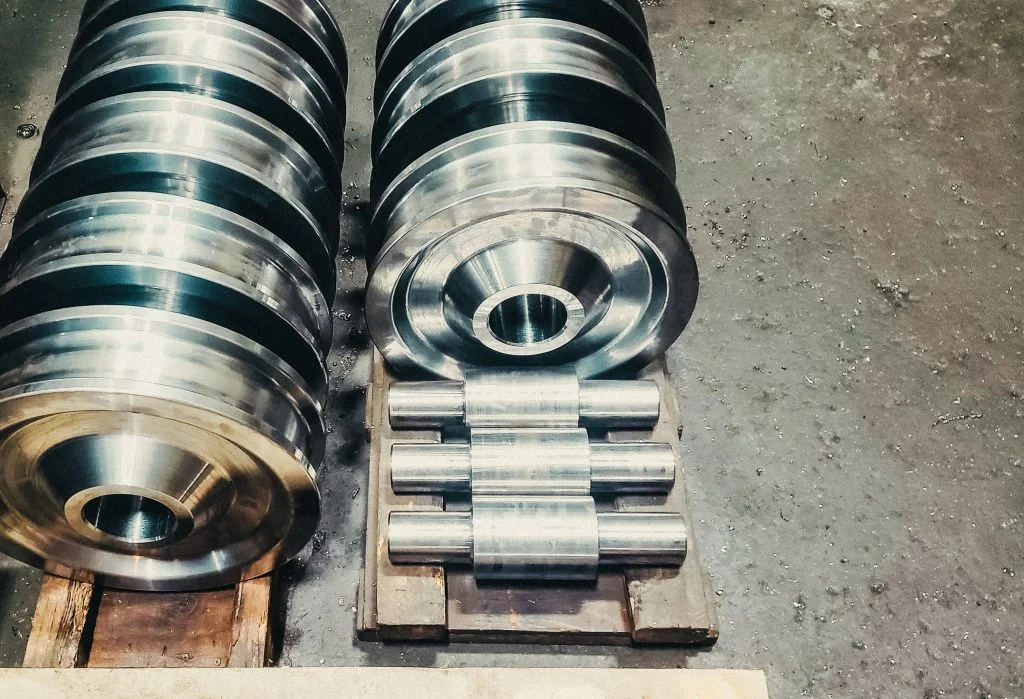
Common Overhead Crane Wheel Failure Modes
Tread Spalling
Surface fatigue fracture of the hardened tread layer. Initiated by cyclic contact stress at or just below the tread surface exceeding the steel's fatigue limit. Most common in Class D and above service with inadequate tread hardness or alloy grade for the actual duty cycle. Visual indicator: irregular pitting or flaking on the tread face. Remedy in replacement: upgrade alloy grade or specify deeper case depth.
Crane Wheel Spalling: Causes and PreventionFlat Spots
Localized flat areas on the tread circumference caused by wheel skid during crane startup or braking. The sliding contact generates frictional heat that briefly softens the tread surface, which then cold-welds to the rail and tears away as the wheel begins rolling. Flat spots create an impact load each revolution that accelerates wear of the wheel, rail, and end truck structure. Remedy: check brake adjustment and drive wheel slip; replacement wheel specification unchanged if flat spots were caused by mechanical issues rather than material failure.
Crane Wheel Flat Spots: Causes and PreventionFlange Wear
Wear on the inner face of the wheel flange from lateral contact with the rail head or web. Indicates the wheel is being pushed against the rail by lateral forces — most commonly from runway misalignment, end truck skewing, or a wheel profile mismatch with the installed rail. If both flanges on the same end truck show wear on the same side, runway alignment is the likely cause. Remedy: address runway alignment; replacement wheel specification may include tighter flange-to-rail clearance review.
Crane Wheel Failure Modes: Root Cause AnalysisOverhead Crane Wheel Capabilities
| Parameter | UTEC Capability |
|---|---|
| Tread Diameter | 6-inch to 48-inch |
| Alloy Grade | AISI 4140 (Class C–D standard), 4340 (Class D–F), 1045 (Class A–B) |
| Tread Hardness | 300–420 BHN (31–45 HRC) for Class C–D; to customer specification |
| Tread Profiles | Flat, tapered, single-flange, double-flange |
| Bore Types | Press-fit, thermal installation, keyed, bearing assembly |
| Drive / Idler | Both positions; drive bore matched to shaft specification |
| CMAA Classes | A through D standard; E and F available — see Ladle & Foundry page |
| OEM Replacement | To P&H, Demag, Konecranes, Whiting, and other major crane OEM specs |
| Documentation | Raw material chemistry, hardness reports, dimensional inspection |
Frequently Asked Questions
What CMAA service classes do UTEC overhead crane wheels cover?
UTEC manufactures overhead bridge crane wheels for CMAA Class A through Class F service. Class A (powerhouse and infrequent use) and Class B (light service, under 2 hours per day) typically use AISI 1045 or 4140 at lower hardness ranges. Class C (moderate service, approximately 50% of rated capacity) and Class D (heavy duty, 50–65% of working time, 5–10 starts per hour) are UTEC's most common overhead crane wheel specifications, using AISI 4140 hardened to 340–400 BHN. For Class E and F overhead crane service — uncommon in standard bridge cranes but found in mill cranes — see the Ladle & Foundry Cranes page.
Can UTEC match an existing OEM overhead crane wheel by part number?
Yes, when the part number comes with the OEM's dimensional data or with photos and measurements of the wheel. UTEC accepts dimensional references for overhead crane wheels from P&H, Demag, Konecranes, Whiting, and other major crane builders — an OEM drawing, data sheet, or manual page lets UTEC quote directly to that specification. If the part number is all you have, send UTEC photos and measurements of the worn wheel — no need to ship the part — for remote reverse engineering; UTEC sends a dimensioned drawing for your approval before machining.
What tread profile is standard for overhead bridge crane runway applications?
The most common tread profile for overhead bridge crane runway wheels is flat tread, which provides the largest contact patch with the flat-head crane rail (ASCE 40, 60, 85, 104, or other standard sizes). Tapered tread is used in applications where self-centering guidance is desired — the taper creates a steering effect that reduces flange contact on straight runway sections. Single-flange and double-flange configurations are both used; the choice depends on the end truck design and whether single-flange paired wheels or double-flange independent guidance is specified. UTEC can manufacture any of these profiles to the rail and clearance requirements specified on the drawing.
What documentation does UTEC provide with overhead crane wheels?
UTEC's standard documentation package for crane wheels includes: complete raw material chemistry documentation (the actual chemical composition of the steel billet used, not just a nominal grade designation); Rockwell hardness test results taken at multiple positions on the tread; and a dimensional inspection report confirming tread diameter, bore diameter, keyway dimensions, and overall width against the drawing. If your application requires supplementary documentation — heat treat certifications, NDE inspection, material traceability to ASTM specifications — specify this at order placement. UTEC can accommodate most quality documentation requirements.
Related Technical Reference
More Crane Wheel Pages
Request a Quote for Overhead Crane Wheels
Tell us your alloy grade, hardness requirement, dimensions, and quantity — or send photos and measurements of your worn wheel. UTEC responds within one business day.
Get a QuoteLast updated: