
Custom Crane Wheels — Your Alloy Grade. Your Hardness Specification.
UTEC Industrial manufactures crane wheels to customer engineering drawings, OEM part numbers, or detailed written specifications. Alloy grade and tread hardness are selected to your requirements — not chosen from a catalog. Precision-machined to ±0.001 inch, hardened in-house, shipped throughout North America.
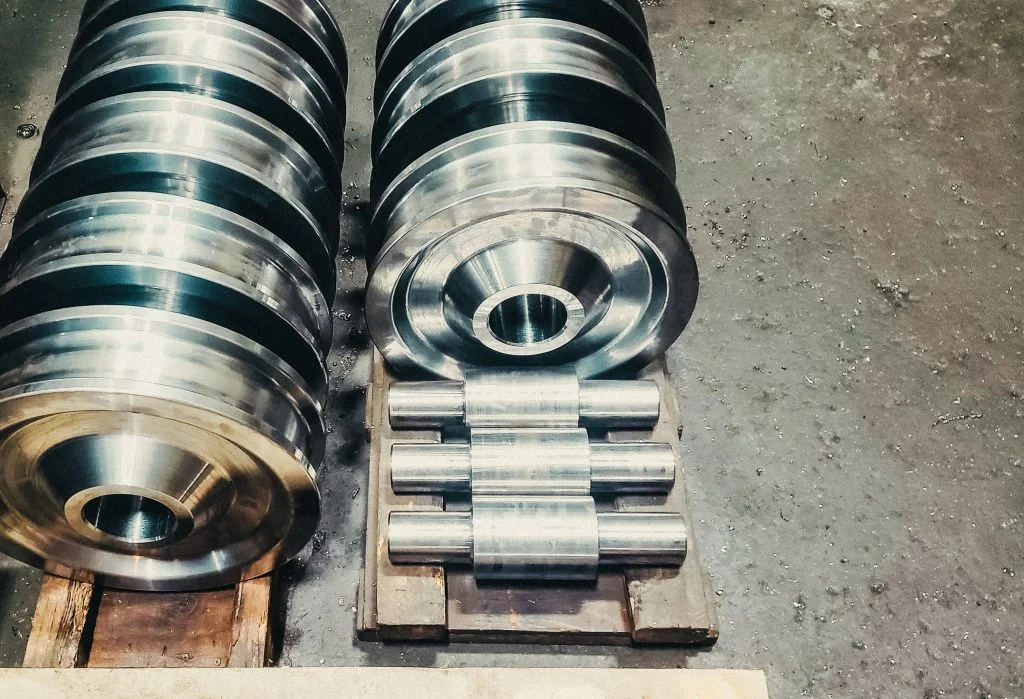
You Specify the Alloy. You Specify the Hardness.
UTEC is not a distributor stocking crane wheels in one alloy at one hardness and shipping from a warehouse. Every wheel UTEC produces is manufactured from scratch to the customer's chemical and hardness specification. If your CMAA (Crane Manufacturers Association of America) Class D overhead crane calls for AISI (American Iron and Steel Institute) 4140 billet hardened to 52 HRC (Rockwell C hardness), that is what UTEC produces. If your Class F ladle crane requires AISI 4340 with a 0.5-inch minimum case depth at 55 HRC, UTEC procures the 4340 billet, machines to your drawing, and hardens in-house to the specified value.
This is not a special capability or an upcharge option — it is UTEC's standard operating mode. Approximately 90% of UTEC's crane wheels are produced to customer drawings or specifications. UTEC provides complete raw material chemistry documentation with every order, confirming the actual chemical composition of the steel used rather than a nominal grade designation on an invoice.
UTEC accepts specifications in any form — a formal engineering drawing, an OEM part number, a written specification sheet, or a phone conversation with your engineering team. There is no single required format.
How to Specify Your Wheel
Engineering Drawing
Send UTEC a dimensioned drawing with material callouts, tolerance requirements, and hardness specification. Accepted formats: DXF, PDF, STEP, IGES, or a dimensioned paper sketch. Inch or metric dimensions accepted. UTEC reviews the drawing, confirms all callouts are complete, and provides a quote within one business day. If any specification gap would affect manufacturing — missing bore tolerance, unspecified keyway, omitted tread profile — UTEC flags it before quoting rather than making assumptions.
OEM Part Number
Provide the crane OEM's wheel part number and the manufacturer name, with the OEM drawing or dimensional data if you have it. UTEC accepts dimensional references for wheels from P&H, Demag, Konecranes, Whiting, and other major crane builders and manufactures to that OEM dimensional specification. If the part number is all you have, send photos and measurements of the existing wheel — UTEC reverse-engineers the geometry and sends a dimensioned drawing for your approval before machining.
Performance Specification
Provide the functional requirements: wheel diameter, bore diameter and fit type, tread profile, CMAA service class, alloy preference, and target Rockwell hardness. UTEC engineers will review the specification for completeness and advise on any gaps — for example, confirming whether the specified alloy achieves the required case depth at the required hardness for the stated service class. Quote provided within one business day of receiving a complete specification.
Choosing the Right Alloy for Your Application
The alloy grade determines the ceiling on achievable tread hardness, the depth of the induction-hardened case, and the wheel's resistance to subsurface fatigue under cyclic loading. If you are replacing a failed or underperforming wheel, UTEC can review the original specification and worn sample and recommend an alloy upgrade if the failure mode indicates the original material was inadequate for the duty.
| Alloy | Best For | Tread Hardness Range | Notes |
|---|---|---|---|
| AISI 1045 | Standard duty, CMAA Class A–B | 54–58 HRC surface; shallow case | Cost-effective for light service; limited hardenability |
| AISI 4140 | Heavy duty, CMAA Class C–D | 50–55 HRC; case depth 0.25–0.50 in | Most common grade for general industrial crane wheels |
| AISI 4340 | Severe duty, CMAA Class E–F | 50–55 HRC; superior case depth uniformity | Nickel addition improves toughness; preferred for ladle and high-impact service |
| AISI 8620 | Case-hardening applications | Hard case, tough core | Used in drive wheels subject to torsional stress |
Crane Wheel Capabilities
| Capability | Specification |
|---|---|
| Raw Material | AISI 1045, 4140, 4340, 8620 — 4140 and 4340 maintained in billet stock |
| Turning Capacity | Up to 48-inch (1219 mm) diameter × 60-inch (1524 mm) length |
| Machining Tolerance | ±0.001 inches on tread diameter and bore |
| Tread Hardness | 50–58 HRC standard; to customer specification |
| Hardening Method | In-house induction hardening — no subcontracting |
| Case Depth | To drawing specification; typical 0.25–0.75 inches |
| Tread Profiles | Flat, tapered, single-flange, double-flange, V-groove, custom |
| Bore Types | Press-fit, thermal installation, keyed, bearing assembly — to IT6/IT7 tolerance |
| Drawing Formats | DXF, PDF, STEP, IGES, paper/sketch, inch or metric |
| Documentation | Complete raw material chemistry, hardness test reports, dimensional inspection |
| Ships To | United States, Canada, Mexico |
Frequently Asked Questions
What file formats does UTEC accept for crane wheel drawings?
UTEC accepts DXF, PDF, STEP, and IGES electronic files, as well as dimensioned paper drawings or hand sketches with clear callouts. Inch and metric dimensions are both accepted. If your drawing was originally in a format you cannot export — for example, a legacy CAD system or a paper original — a clear photograph or scan with key dimensions legible is a workable starting point. UTEC will identify any missing dimensions or callouts and ask for clarification before quoting.
Can UTEC manufacture crane wheels to metric dimensions?
Yes. UTEC produces crane wheels to metric dimensional specifications, including bore diameters in ISO fit designations (H7, f7, etc.), tread widths and diameters in millimeters, and keyway dimensions to DIN or ISO standards. If your drawing mixes inch and metric dimensions — common on older crane equipment — call UTEC to confirm the drawing is unambiguous before quoting.
What Rockwell hardness values can UTEC achieve with in-house induction hardening?
For AISI 4140, UTEC can achieve tread surface hardness in the range of 50–58 HRC with case depths of 0.25–0.50 inches. For AISI 4340, the same hardness range is achievable with more uniform hardness distribution through thicker sections and case depths up to 0.75 inches for larger-diameter wheels. For AISI 1045, maximum achievable surface hardness is approximately 56–58 HRC but with a shallow case that drops off rapidly below 3/8 inch. Tread hardness above 58 HRC can increase brittleness and is generally not specified for crane wheel service; UTEC will flag any hardness specification that exceeds typical practice for the stated alloy and service class.
Can UTEC manufacture a wheel to a different alloy than the original OEM specification?
Yes, with customer approval. Alloy upgrades — from 1045 to 4140, or from 4140 to 4340 — are appropriate when the original specification was inadequate for the actual service class, when the crane has been reclassified to higher duty since original specification, or when failure analysis of the old wheel indicates subsurface fatigue or insufficient case depth. UTEC can review the original specification, the observed failure mode, and the current duty cycle and recommend the appropriate upgrade. Any change from the original OEM specification is confirmed with the customer before manufacturing.
What is the minimum order quantity for custom crane wheels?
UTEC does not publish a minimum order quantity for crane wheels. Single wheels, pairs, and full sets of end truck wheels are all accepted. For very small-diameter wheels (under 8 inches) or unusual profiles, contact UTEC to confirm applicability — the minimum practical lot size may be one wheel, or it may be two if tempering batch requirements make a single wheel uneconomical. For standard overhead crane wheel diameters (12–30 inches) in common alloy grades, there is no practical minimum order quantity above one wheel.
Explore All Crane Wheel Solutions
Submit a Drawing or Specification for a Quote
Send UTEC your drawing, OEM part number, or written specification. UTEC responds within one business day with a quote and any clarifying questions.
Email Drawing — Get a QuoteLast updated: